In the hierarchy of the fashion industry, the "Site Model" (frequently referred to as the E-Commerce Model) is often the hardest working and highest earning demographic.
They are not walking the runway at Paris Fashion Week in avant-garde geometric plastics. Instead, they are the relatable, athletic, flawlessly proportioned talent wearing next season's yoga pants on the Nike website. Because e-commerce retailers upload thousands of new stock items to their websites every single month, they require an absolute army of site models on constant retainer.
If you want to transition from erratic freelance gigs into a highly lucrative, consistent site-modeling career, your digital portfolio must speak the exact language of an e-commerce casting director. You cannot submit an edgy, high-fashion portfolio. You must optimize for commercial visibility. Here is the blueprint.
The Strategy of 'The Blank Canvas'
An e-commerce Art Director is currently staring at a rack containing eighty different highly-patterned summer dresses that need to be photographed tomorrow.
If your portfolio is full of images where you are wearing insanely complex vintage clothing and heavy contouring makeup, the director cannot mentally picture you wearing their dresses. You are causing them cognitive friction.
A successful site model portfolio strip-mines all personal style. Your primary gallery should feature you as the ultimate "Blank Canvas."
- Wardrobe: Wear rigid, unbranded basics (a perfectly fitted white t-shirt, standard blue denim, and plain white sneakers).
- Expression: Friendly, approachable, and awake.
- Backdrop: Completely neutral studio white or gray.
By removing your personal fashion identity, you allow the casting director to effortlessly project their brand's identity onto your face.
Demonstrating High-Speed Pose Variation
The fundamental skill of a site model is stamina. On an e-commerce set, you are expected to change into an outfit, step onto the white backdrop, execute six distinct poses in thirty seconds, step off, and change into the next outfit. You might do this ninety times in one day.
Your portfolio layout must explicitly prove that you possess this mechanical posing speed.
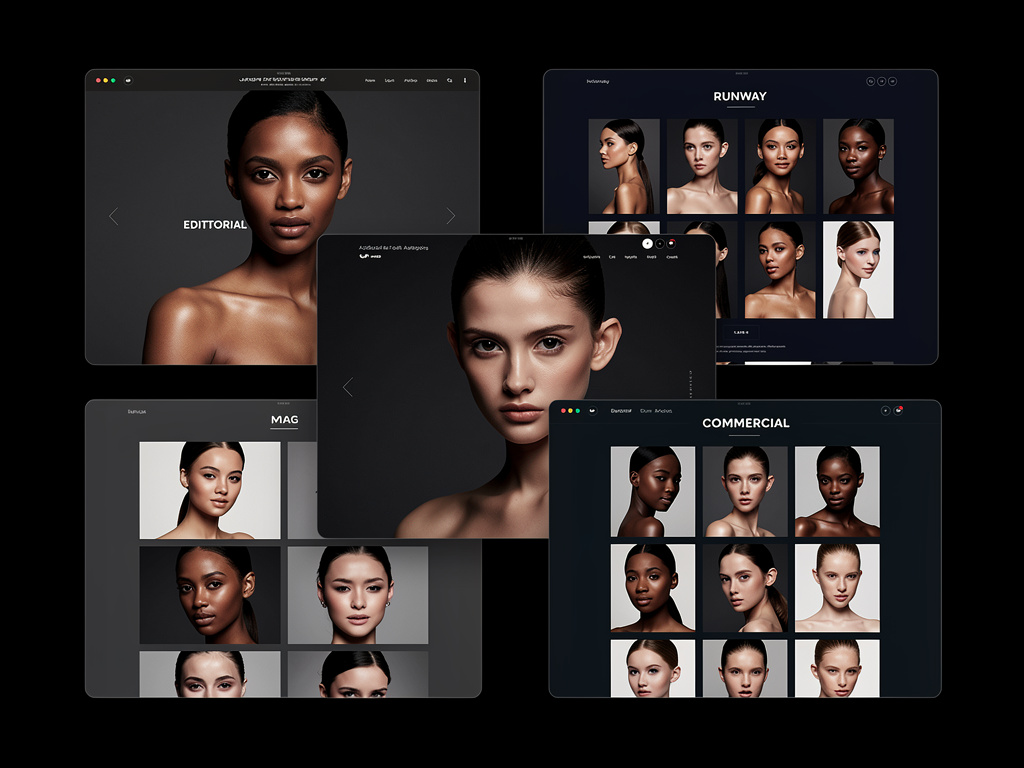
Do not just upload your one favorite photo from a commercial shoot. Upload the "Contact Sheet Grid." Utilize a dense, 4-column masonry layout on your website specifically to show an entire, uninterrupted sequence of twelve photographs from a single outfit. Show the director that you effortlessly transitioned from a front-facing stance to a 3/4 turn, to a dynamic walking pose, to a tight jacket-detail crop, all without losing your facial energy. Volume proves competence.
Optimizing The 'Lifestyle' Pivot
While the majority of e-commerce modeling happens inside a sterile white studio, a massive secondary revenue stream is the "On-Location Lifestyle" shoot.
Brands need models who look equally comfortable drinking coffee on a busy city street as they do in the studio. However, do not mix your sterile studio shots directly into your noisy lifestyle shots. It shatters the web layout.
Create a strict secondary gallery titled "Commercial Lifestyle." Inside this gallery, upload high-resolution images of yourself interacting naturally with realistic environments. Show yourself laughing organically while holding a prop (like a phone or a coffee cup). The goal is to look like an incredibly photogenic consumer, not a rigid, untouchable mannequin.
Ensuring Unmetered Image Delivery
Commercial agencies operate at blistering speeds. When they are building an internal pitch deck, they frequently copy and paste images directly from your website.
If your digital portfolio heavily compresses your images, or applies annoying watermark overlays to prevent downloading, you are actively fighting the agency attempting to hire you.
You must utilize an infrastructure designed for B2B commercial exchange. By running your portfolio on Portfoliobox, site models guarantee their massive 4K commercial photography is delivered through unmetered, lightning-fast CDNs natively — allowing casting directors to extract perfect, uncompressed visuals for their mood boards globally, with no coding required.