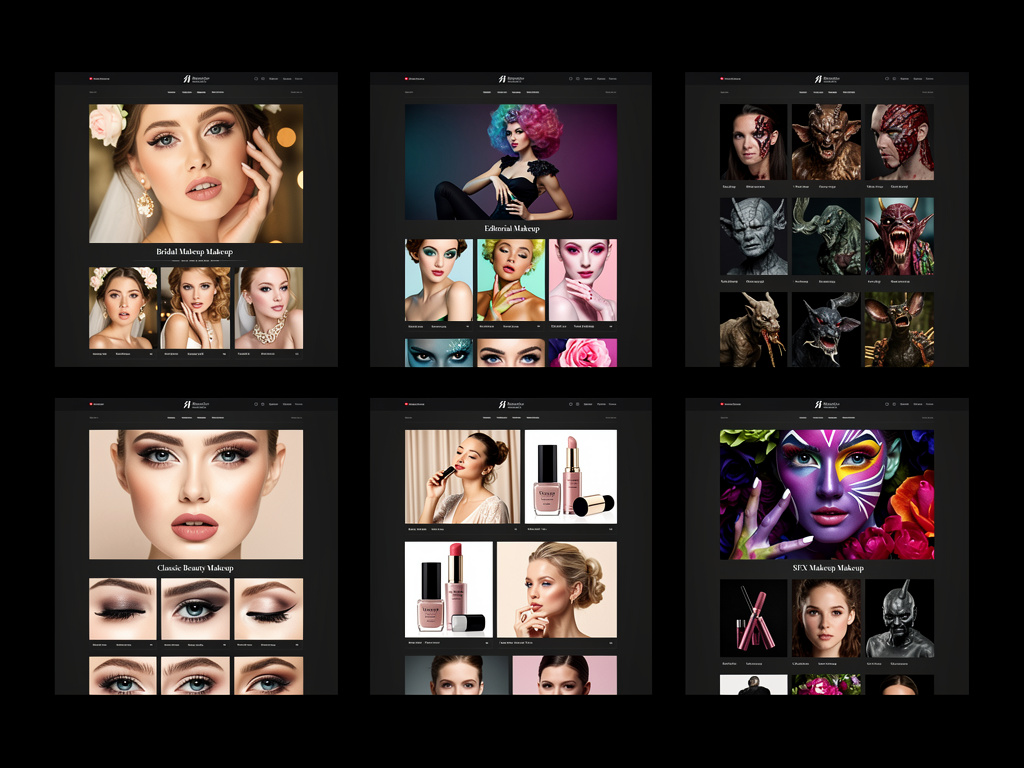
While standard cosmetic makeup is designed to enhance beauty, Special Effects (SFX) Makeup is designed to construct entirely new realities.
SFX Artists are not just painters; they are sculptors, chemists, and character designers. When a high-level Film Director or a massive production studio is crewing up for a sci-fi thriller or a period drama, they are evaluating your portfolio based on your ability to manufacture unbelievable illusions that survive the ruthless scrutiny of a 4K cinema camera.
Many incredibly talented SFX artists fail to book films because they structure their websites exactly like wedding makeup artists. They post chaotic grids of Halloween looks mixed with standard glamour shots. This is a massive B2B failure. A Film Producer needs to see specific technical execution. Here is the exact architectural blueprint for structuring your SFX portfolio to secure film and television contracts.
1. Siloing the 'Creature' vs The 'Casualty'
The SFX industry is highly compartmentalized. A Director hiring an artist to create realistic bullet wounds for a gritty crime drama does not want to click through twenty pictures of a six-armed alien monster.
You must strictly silo your portfolio into specific technical disciplines. Establish these primary navigation categories:
- Character Prosthetics: (Old age stippling, alien features, fantasy sculpting).
- Trauma & Casualty: (Hyper-realistic bruises, lacerations, burns, and surgical gore).
- Hair & Postiche: (Applying beards, bald caps, and wigs flawlessly).
By fracturing your website into these distinct technical categories, the film producer can instantly jump to the exact skill-set their current script mathematically requires.
2. Documenting the Prosthetic Process
In high fashion, the client only cares about the final retouched image. In SFX, the client cares intensely about how you built it.
If you upload a photograph of an incredible silicone zombie mask, the Director needs to know: Did you sculpt this from scratch, or did you just glue a store-bought piece onto an actor?
You must utilize a "Process Breakdown" layout format. Whenever you upload a major 'Hero' SFX piece, you must provide a 3-column chronological grid immediately below it.
- Image 1: The lifecasting of the actor's bare face.
- Image 2: Your raw clay sculpture sitting on your workbench.
- Image 3: The unpainted silicone or foam latex prosthetic prior to application.
By aggressively showing your messy, highly-technical workbench process, you prove to the Producer that you are a legitimate foundational sculptor, instantly justifying a premium daily union rate.
3. The Mandate of Continuity Proof
The single hardest technical challenge for an SFX artist in television is 'Continuity'. If an actor sustains a black eye in Episode 1, that bruise must slowly heal, change color, and slightly fade across Episodes 2, 3, and 4.
A brilliant SFX portfolio actively proves continuity logic. Create a specific "Continuity Studies" gallery. Upload a rigid grid showing a single wound aging across three distinct stages. When a Television Producer sees that you possess the meticulous organization and color-theory required to match a bruise perfectly on a Tuesday that you originally painted three weeks earlier, they will hire you immediately.
4. Uncompressed Macro Realism
The camera never blinks. In modern cinema, a 4K lens will expose the microscopic edge of a bald cap or the seam of a silicone cheekbone instantly.
Your digital portfolio must prove that your edges are invisible. You must mandate uncompressed, lightning-fast Macro-photography on your website. Allow the Production Designer to digitally zoom directly into the edge of your prosthetic application. Prove that your blending is flawless without the help of Instagram blurring filters.
Breaking into the cinematic union demands absolute technical transparency. By orchestrating your SFX layouts on Portfoliobox, artists secure the uncompressed visual grids, stark dark-mode layouts, and process-driven architecture required to prove their mastery to Hollywood executives — no coding required.