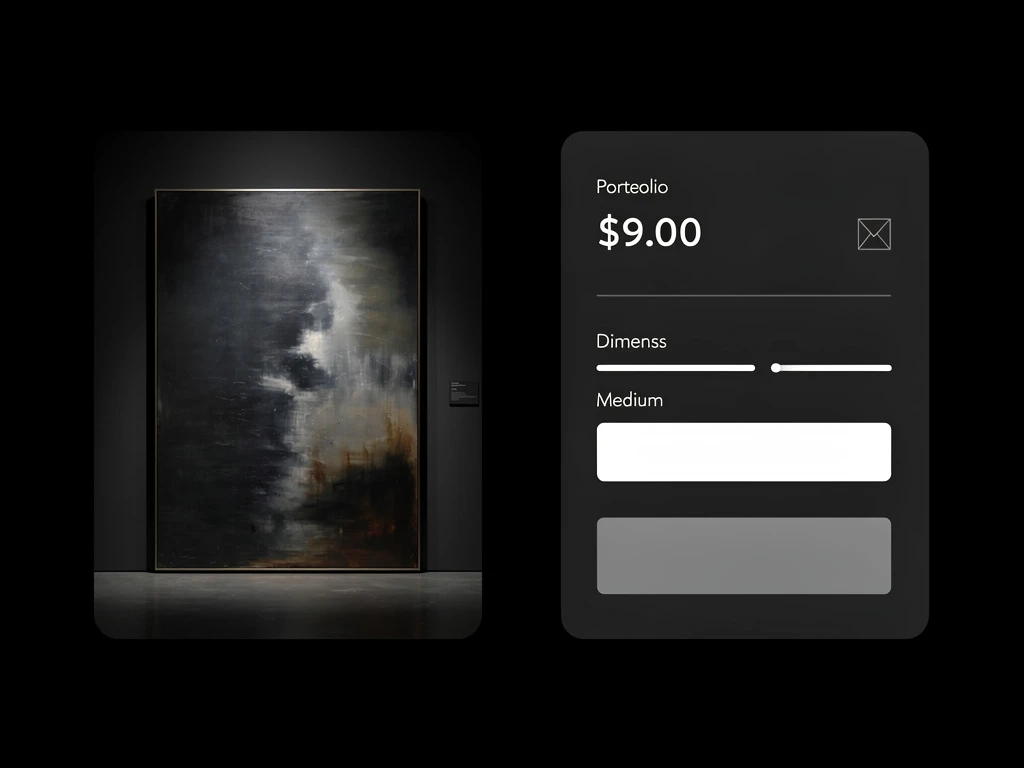
When traditional fine artists try to secure gallery representation, they often focus entirely on the quality of their brushstrokes. While technical mastery is non-negotiable, it is only half of the equation.
Gallery curators and high-end collectors are effectively art directors. They are not just looking for a pretty picture; they are looking for a cohesive vision, a reliable brand, and a narrative they can sell. If your website is a chaotic collection of random paintings, a curator will immediately pass on you. To secure major exhibitions, you must stop presenting your work like a student and start presenting it like a professional. You must build your website to function like a high-end art director portfolio. Here is how to solve the most common presentation problems.
The Problem: The "Jack of All Trades" Trap
Many artists think that showing versatility makes them more employable. They upload a hyper-realistic charcoal portrait next to a vibrant abstract acrylic pour, followed by a digital logo design.
To a curator, this doesn't look like versatility; it looks like a lack of commitment. Curators want to represent artists who have mastered a specific visual language. They want to sell a distinct brand.
The Solution: Ruthless Thematic Curation
An art director portfolio is heavily curated. You must treat your website like a focused exhibition. How to apply it: Group your work into specific "Series" or "Collections." If you are currently exploring moody, atmospheric landscapes, your primary gallery should feature only moody, atmospheric landscapes. Hide your stylistic experiments on a secondary page or remove them entirely. You must present a unified, confident artistic voice.
The Problem: Lack of Narrative Context
If you just upload a flat JPEG of a painting with the title "Untitled #4," you are forcing the curator to do all the emotional heavy lifting. High-end art sales are driven by the story behind the piece just as much as the piece itself.
The Solution: Deep-Dive Case Studies
An art director wants to know how you think. How to apply it: Create dedicated project pages for your most important works. Include the final painting, but also include process shots: a photo of your messy palette, your charcoal underpainting, or the initial sketches. Write a brief artist statement (two paragraphs maximum) explaining the thematic concept driving the work. This demystifies your process and adds immense intellectual value to the final canvas.
The Problem: Poor Visual Pacing
Cramming 40 paintings into a tight, edge-to-edge square grid on your homepage is visually exhausting. A curator will become overwhelmed and leave.
The Solution: The "White Cube" Aesthetic and Asymmetry
An art director understands that negative space is a tool used to dictate importance. How to apply it: Replicate the aesthetic of a high-end contemporary gallery. Use stark white backgrounds and minimalist typography. Ditch the uniform grid and use an asymmetrical masonry layout. Increase the padding between your images significantly. This invisible digital frame forces the curator to pause and absorb the physical details of each painting independently, creating a luxurious viewing experience.
Curators want to work with professionals. By structuring your website with the rigor of an art director portfolio, you prove your market readiness. With Portfoliobox, you can seamlessly apply these high-end, minimalist curatorial strategies to build an agency-grade fine art website in minutes — no coding required.