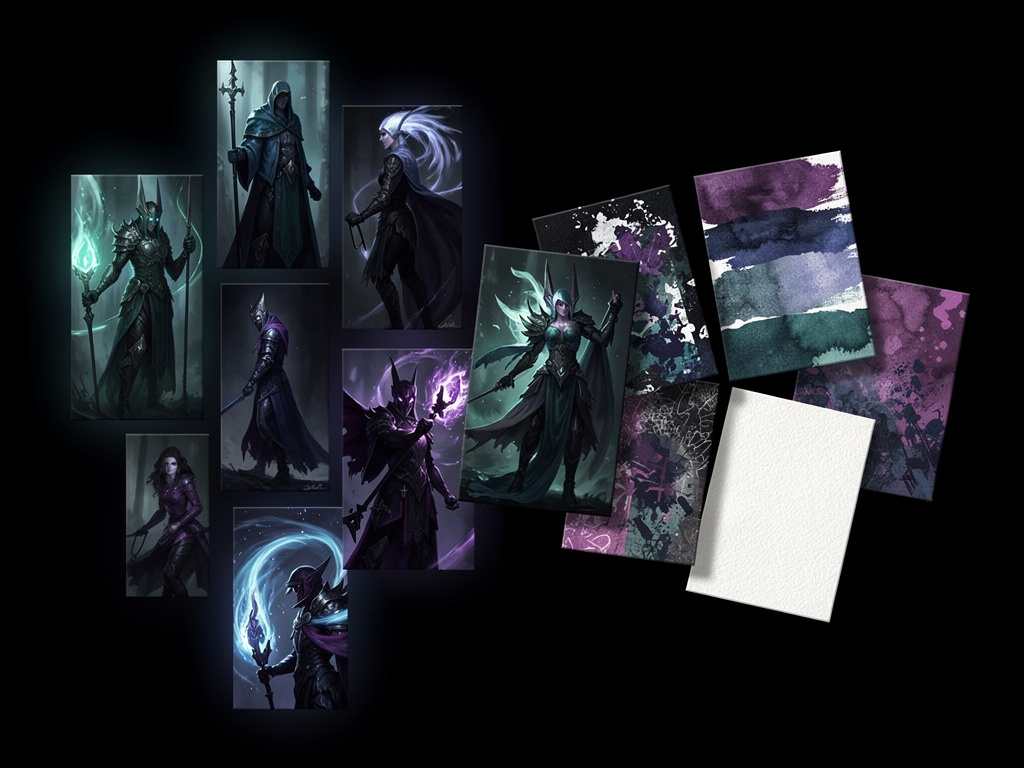
The modern digital illustrator faces a brutal paradox. To secure $10,000 corporate commissions from publishing houses or video game studios, an artist must publicly display high-resolution, incredibly detailed examples of their talent online.
However, the moment a flawless, high-resolution JPEG is uploaded to the internet, it becomes vulnerable. Generative Artificial Intelligence (AI) algorithms scrape the image to train their datasets natively. Disreputable overseas manufacturing companies download the file and immediately print it onto thousands of cheap t-shirts and coffee mugs, stealing the artist's Intellectual Property (IP) for massive profit.
Driven by justifiable fear, many illustrators panic. They attempt to "protect" their artwork by completely destroying its visual fidelity—plastering massive, ugly red watermarks directly across the center of their beautiful fantasy paintings. The result? They stop the thieves, but they also stop Art Directors from hiring them.
You must strike a mathematical balance. Here is the B2B protocol for protecting your illustrations online without destroying your commercial conversion rate.
The Delicate Science of the Watermark
If an Art Director from Marvel Analytics clicks your portfolio and sees a gigantic, semi-transparent logo covering the face of the superhero you just painted, they cannot evaluate your brushstrokes. You have obscured your own talent.
The B2B Execution: A professional watermark is not meant to stop a determined, elite digital hacker. It is meant to stop casual corporate theft and prove legal ownership.
- Opacity is Everything: Your watermark should never exceed 15% opacity. It should sit quietly inside the artwork, not scream over it.
- Corner Anchoring: Never place the watermark in the absolute center of the focal point. Tuck it into the compositional corners of the grid.
- The 'Glaze' Technique: For extreme protection, utilize a digital "noise glaze." Place a microscopic, barely perceptible layer of digital film grain over the entire JPEG. It does not look bad to the human eye, but it violently disrupts the mathematical scraping efficiency of many generative AI training models.
Down-Res Sizing: The Ultimate Defense
The single most effective way to prevent a t-shirt company from stealing and printing your artwork is simply denying them the math required to do so.
Professional printing presses require a massive amount of pixel density (measured in Dots Per Inch, or DPI). A standard 11x14 inch corporate poster must be printed at 300 DPI to look sharp. This results in a massive file size (frequently exceeding 50 Megabytes).
The Digital Chokehold: You must never upload a 300 DPI file to your public website. Before uploading, mathematically shrink your artwork to 72 DPI or 96 DPI. Ensure the longest physical edge of the JPEG never exceeds 1500 pixels.
At this precise mathematical size, the image looks incredibly sharp, beautiful, and fully detailed on a smartphone or a Macbook retina screen (satisfying the Art Director). However, if a thief downloads that exact image and attempts to print it on a t-shirt, the ink will violently blur into massive, pixelated blocks, rendering it completely unsellable. You have weaponized the screen resolution natively.
Implementing 'Right-Click Disable' Protocols
The final layer of defense is behavioral disruption.
Most casual art theft occurs when a lazy merchant right-clicks your web gallery, selects "Save Image As," and drags it to their desktop.
Professional portfolio builders frequently allow illustrators to natively activate a "Right-Click Disable" script. This simple line of code prevents the standard browser download function. While a highly technical user can still find ways around it (like taking a localized screenshot, which further destroys the image quality anyway), disabling the right-click functionally stops 90% of casual drag-and-drop theft instantly.
Protecting your livelihood requires a digital infrastructure that fights back. By building your illustration brand on Portfoliobox, independent artists effortlessly integrate right-click disabling, password-protected client galleries, and image-safe formatting architecture capable of projecting elite aesthetics while violently deterring B2B theft — no coding required.