There is a massive, often painful difference between being a talented "Illustrator" and being a hirable "Concept Artist."
An illustrator's primary job is to create a single, beautiful, finished image (like a movie poster or a book cover). A Concept Artist's primary job is entirely different: they are hired to design blueprints. Their artwork is handed down an massive production pipeline to 3D modelers, riggers, and animators who must turn their 2D design into a functional, moving 3D asset for a video game or an animated film.
Thousands of young artists send their online portfolios to massive studios like Pixar or Blizzard containing breathtaking, fully-rendered paintings of original characters. These applications are almost universally rejected. The studio Art Director doesn't need to see that you can spend forty hours rendering a single painting; they need to see that you understand structural geometry.
Here is exactly how to format and prepare your concept art portfolio to survive the ruthless vetting of the entertainment industry.
The Mandate of the 'Orthographic Turnaround'
If you design a beautiful knight with incredibly complex armor, but you only draw them from a dramatic 3/4 front angle, a 3D modeler cannot build that character. They have no idea what the back of the armor looks like, or how the sword attaches to the hip.
To prove you are a legitimate Concept Artist, your portfolio must prioritize "Orthographic Turnarounds" (Model Sheets). When you upload a character design to your website, the primary image should be a flat, un-stylized lineup of that character drawn perfectly from the Front, Side, and Back profiles.
These images shouldn't be heavily painted or dramatically lit. They should be clean, mathematically aligned line-art. By prioritizing structural blueprints over beautiful illustrations, you instantly speak the language of the production pipeline.
Demonstrating 'Expression and Iteration'
Studios do not hire artists who get married to their very first idea. Game development requires endless iteration. If an Art Director asks you to redesign a character's face thirty times, you must show that you possess the creative stamina to do so.
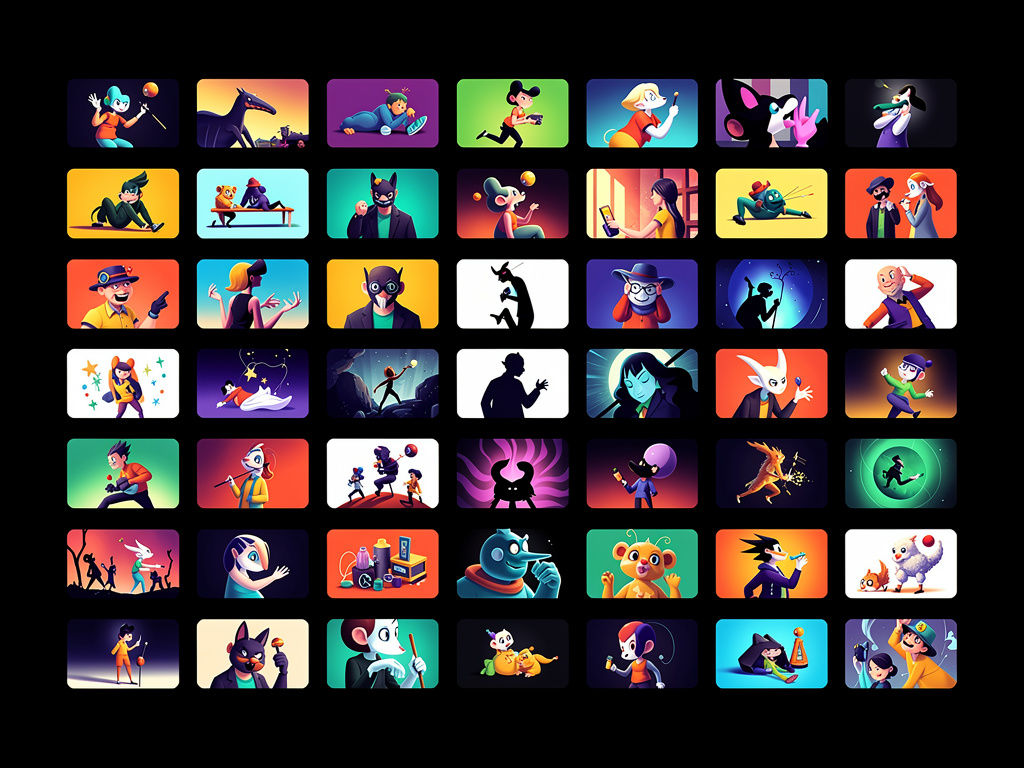
The Portfolio Solution: Create dedicated "Iteration Grids" on your website. Instead of only uploading the final design of an alien creature, upload a massive grid containing forty fast, messy, black-and-white silhouette sketches exploring wildly different body shapes for that alien.
Immediately below this, include an "Expression Sheet"—a storyboard showing the finalized character's face reacting in five different extreme emotional states (Anger, Joy, Fear, Disgust, Sorrow). This proves to the animation team that the facial anatomy you designed can actually stretch and contract realistically without breaking the model.
The Danger of 'Over-Rendering'
Young concept artists frequently make the mistake of aggressively rendering every single material in their portfolio to hyper-realistic perfection, spending hours painting the exact reflective light on a leather boot.
In a real studio environment, you will rarely have the time to render an image fully. You are expected to design ten different swords in two hours.
Your portfolio must prove your speed and efficiency. Include a specific gallery section showcasing your "Flat Color" designs and "Line Art." Prove that your designs are incredibly strong based purely on their structural silhouette, completely independent of complex painting techniques. An Art Director will always hire the artist who can generate fifty great ideas quickly over the artist who generates one great idea very slowly.
Breaking into massive entertainment studios requires an online presentation that proves structural restraint. By utilizing Portfoliobox, concept artists can deploy highly organized, uncompressed masonry grids to perfectly showcase their complex orthographic turnarounds and massive iteration sheets without sacrificing legibility — no coding required.