Take a moment to analyze the digital portfolios of the most revered, Pritzker-winning architectural firms currently practicing. From Tadao Ando to Peter Zumthor, you will notice a staggering, unified digital aesthetic: almost terrifying emptiness.
Their websites are completely devoid of chaotic animations, complex drop-down menus, flashy 'about us' counters, or dense sidebars. They present their lifetime of complex structural engineering using brutally sparse, aggressively minimalist web layouts.
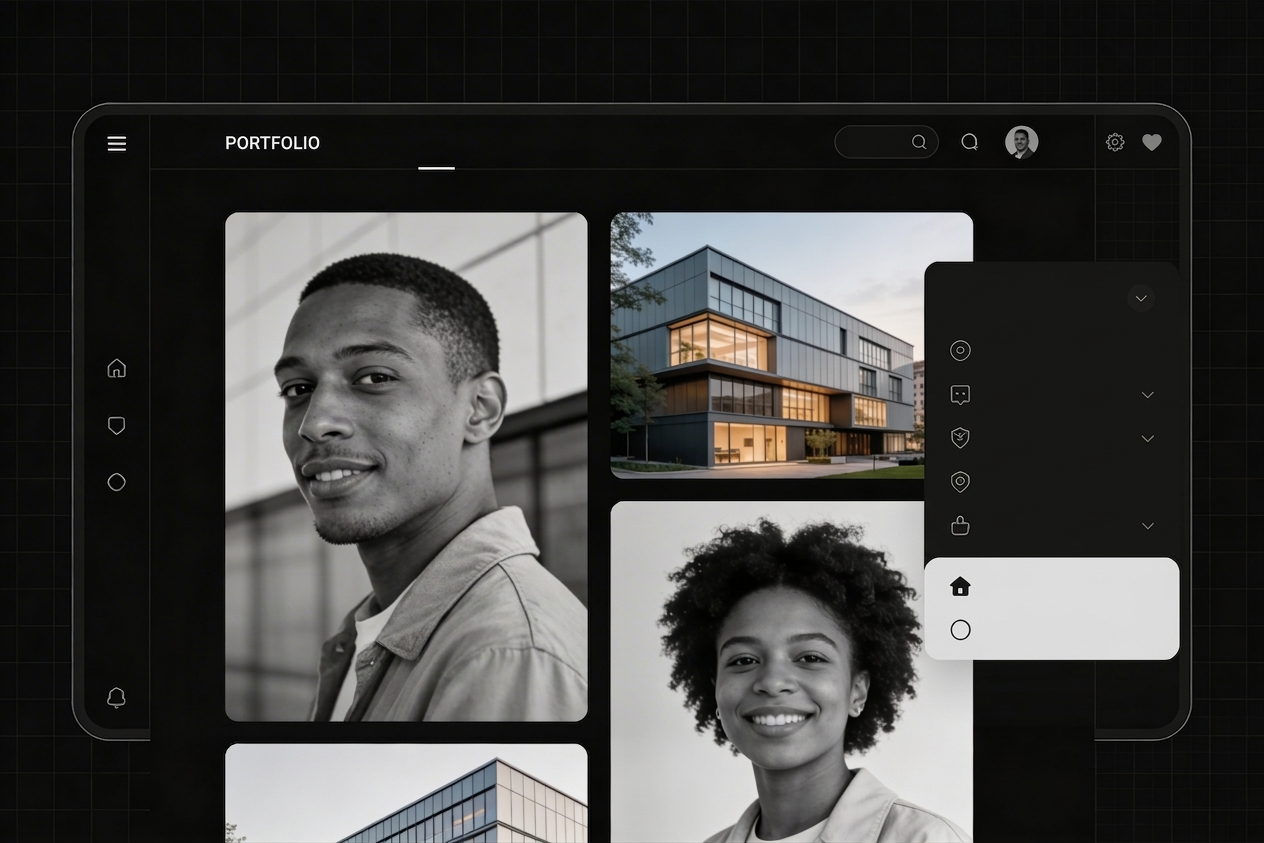
This is not a coincidence. It is a highly calculated psychological strategy. The core tenet of minimalist architecture portfolio design is understanding that your building is the protagonist; the website is merely the concrete floor it stands upon. If the floor is painted neon pink, nobody looks at the building. Here is how to construct an invisible, perfectly minimalist digital frame for your architectural work.
The Domination of 'Negative Space'
In graphic design, elements are often meant to touch and interact tightly. In architecture, elements require spatial breathing room.
The cardinal rule of minimalist portfolio design is the aggressive utilization of negative space (often referred to as 'white space', regardless of the actual background color). When you upload a dense, highly detailed elevation rendering, you must surround that image with massive, empty digital margins.
Do not allow photographs to bump into paragraphs of text. Do not crowd four distinct floor plans into a single horizontal row. By artificially isolating an architectural drawing in a vast expanse of emptiness, you force the viewer's eye to slow down. You demand that they study the technical precision of your line-work, rather than allowing their eye to bounce chaotically around a cluttered screen.
Typographical Silence
If your website architecture is quiet, your typography must whisper.
Many young architects make the mistake of using excessively "design-y," complex, or thin hairline fonts in an attempt to look sophisticated. This invariably causes legibility issues when scaled down to a mobile phone screen, disrupting the minimalist peace.
A premium minimalist portfolio relies on 'Typographical Silence'. Select exactly one highly structural, beautifully engineered sans-serif font (like Helvetica Neue, Inter, or Roboto). Use it universally across your entire domain.
- The Navigation menu should be tiny and unobtrusive.
- The Case Study headers should be bold but appropriately scaled.
- The Body paragraphs should utilize perfect line-height (leading) to ensure maximum legibility without screaming for attention.
Removing Navigation Friction
The fastest way to ruin a minimalist aesthetic is through complex, multi-tiered dropdown menus that act like an obstacle course.
When an Art Director or a potential client lands on your homepage, they should not have to read a complicated map to find your work. The navigation should be brutally flat. The most successful minimalist portfolios often reduce their entire navigation structure down to exactly three words: Work. Profile. Contact.
If you have sub-categories (like Residential vs Commercial), do not hide them in annoying hover-menus. Implement them as clean, lateral text filters directly on the main 'Work' page. Frictionless navigation maintains the serene, elevated tone required of high-end architecture.
The Monochrome Baseline
Architecture is inherently colorful (materials, landscapes, skies). Therefore, your digital portfolio interface must be completely agnostic to color.
If your website background or primary button color is a vibrant blue, it will inevitably clash with the warm, sunset-lit rendering of your brick facade project on the next page. A truly minimalist portfolio adopts a strict monochrome baseline. The background is white (or dark gray for dark-mode sites). The text is black. The navigation links only change opacity, not hue, when clicked. By removing color from the UI interface, the only color the viewer experiences is the color generated by your actual architecture.
Perfecting digital minimalism is impossible if you are using a clunky, heavily-coded website builder. With Portfoliobox, architects can instantly leverage natively stripped-down, brutally clean structural templates that enforce pristine margins and typographical silence — no coding required.