When you graduate from a rigorous design program, your first digital portfolio serves a very explicit purpose: proving you understand the basic software tools and can execute a fictional creative brief without adult supervision.
However, as you transition from a junior designer making banner ads to a senior Art Director overseeing million-dollar international campaigns, the requirements of your digital portfolio shift dramatically. A senior leader cannot rely on the same rigid, masonry-grid portfolio template they used as a twenty-two-year-old student.
Your website architecture must evolve to reflect your escalating strategic value. If you are struggling to land higher-paying roles, the problem might not be your visual work—it might be that your layout template is actively suppressing your senior-level expertise. Here is how to transition your digital portfolio across the three critical stages of a design career.
Level 1: The Junior Designer (The Evidence Grid)
When you are fighting for your first real agency job, creative directors need immediate, overwhelming visual evidence that your technical skills are sharp. They do not have time to read your theories on typography.
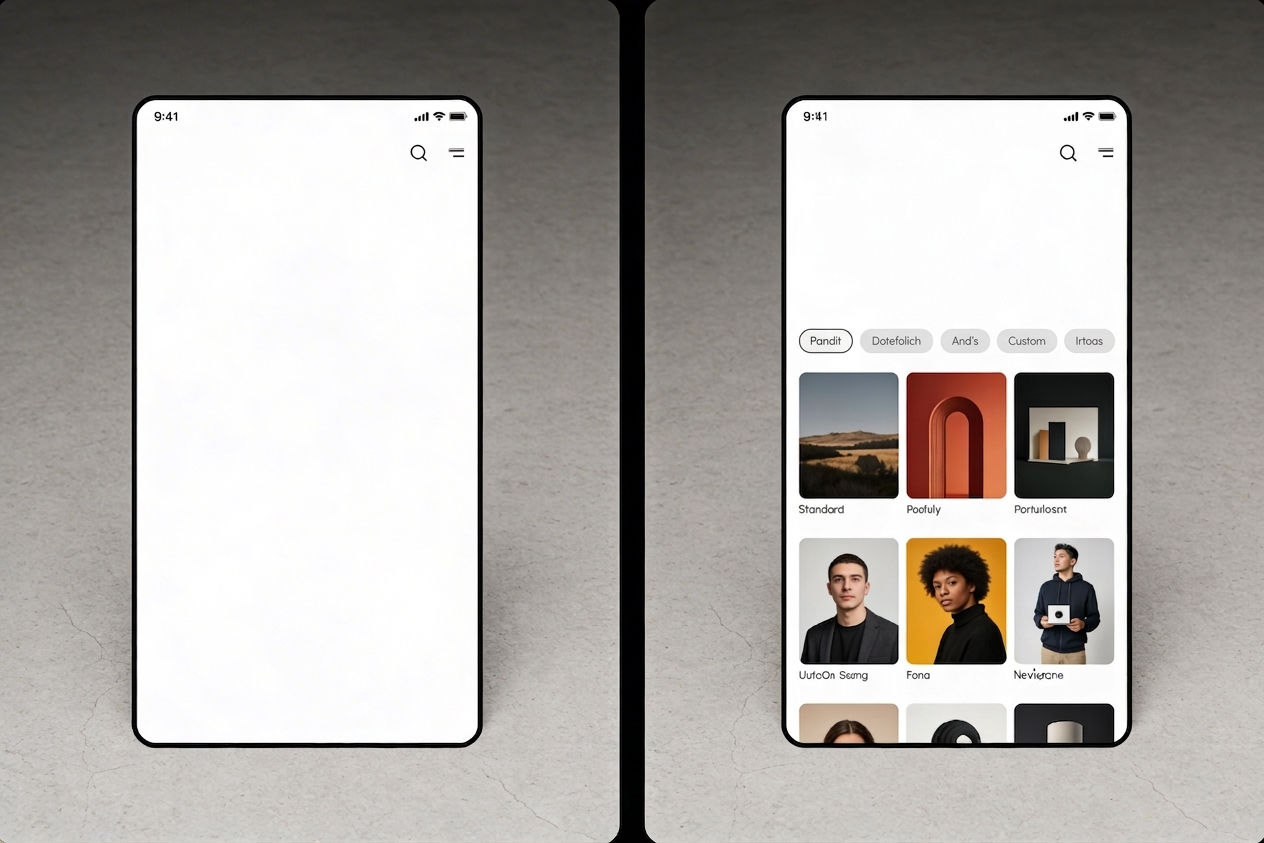
The Template Strategy: At this stage, you need a high-impact, visual-first template. Focus on a massive masonry or standard grid layout right on the homepage. Reduce the copywriting to an absolute minimum. The goal is to aggressively display variety: brand identities, motion graphics, and UI screens. You want the agency to see a wall of undeniable technical competence the absolute second the page loads.
Level 2: The Mid-Level Designer (The Case Study Shift)
After three to five years in the industry, nobody cares if you know how to use the Pen Tool in Adobe Illustrator. That is assumed. At the mid-level career stage, agencies hire you for your conceptual thinking and your ability to bring a real-world client brief across the finish line.
The Template Strategy: The sprawling "wall of work" grid from your junior years is now actively hurting you. You must transition your template format toward Case Studies.
Instead of showing fifty disparate graphics, your homepage should feature only six to eight massive "Hero" images, each linking directly to an expansive sub-page. These template pages must support complex, interlaced text and image blocking. You need space to write out the marketing problem, outline the structural challenges faced during production, and finally display the polished outcome. A mid-level designer proves their worth by proving they can solve problems, not just make pretty graphics.
Level 3: The Senior Creative Director (The Strategic Narrative)
When you reach the senior echelons—Creative Director, Lead UX Strategist, Head of Brand—you are no longer selling your ability to design a logo. You are selling your ability to lead entire departments, write comprehensive design systems, and shift corporate revenue via aesthetics.
The Template Strategy: At this level, a rigid image-based portfolio template is completely useless. A senior portfolio requires an almost editorial, magazine-like digital architecture.
The template must be heavily typographic and narrative-driven. It requires massive amounts of negative space (whitespace) to exude confidence and luxury. You only present three or four massive legacy campaigns. The layout must support embedding video sizzle reels, deep-dive strategic PDF reports, and organizational charts showing how you scaled a design team. The website itself must operate flawlessly as a testament to your ultimate creative judgment.
Ditching the Rigid Theme
The fatal flaw of traditional website builders is forcing designers to buy a permanent, locked "Theme." As you scale from Junior to Senior, you cannot afford to delete your entire website and rebuild from scratch simply because you've outgrown the template limits.
You require a system constructed with dynamic, independent blocks. This allows you to effortlessly transition from a visual-heavy grid into a text-heavy, strategic case-study architecture without ever breaking your core code.
Stop letting a cheap template dictate your career trajectory. With Portfoliobox, you scale effortlessly utilizing completely dynamic, modular creative architecture that grows perfectly alongside your design seniority — no coding required.