ImageNation Barcelona 2026 | Selected Photographer
The photographer & the work
Street photography operates on split-second timing and an almost meditative awareness of visual possibility. Álvaro Vegazo has mastered both. His selected work for ImageNation Barcelona is a lesson in how to construct meaning from the chaos of public space, how to see a frame within the frame.
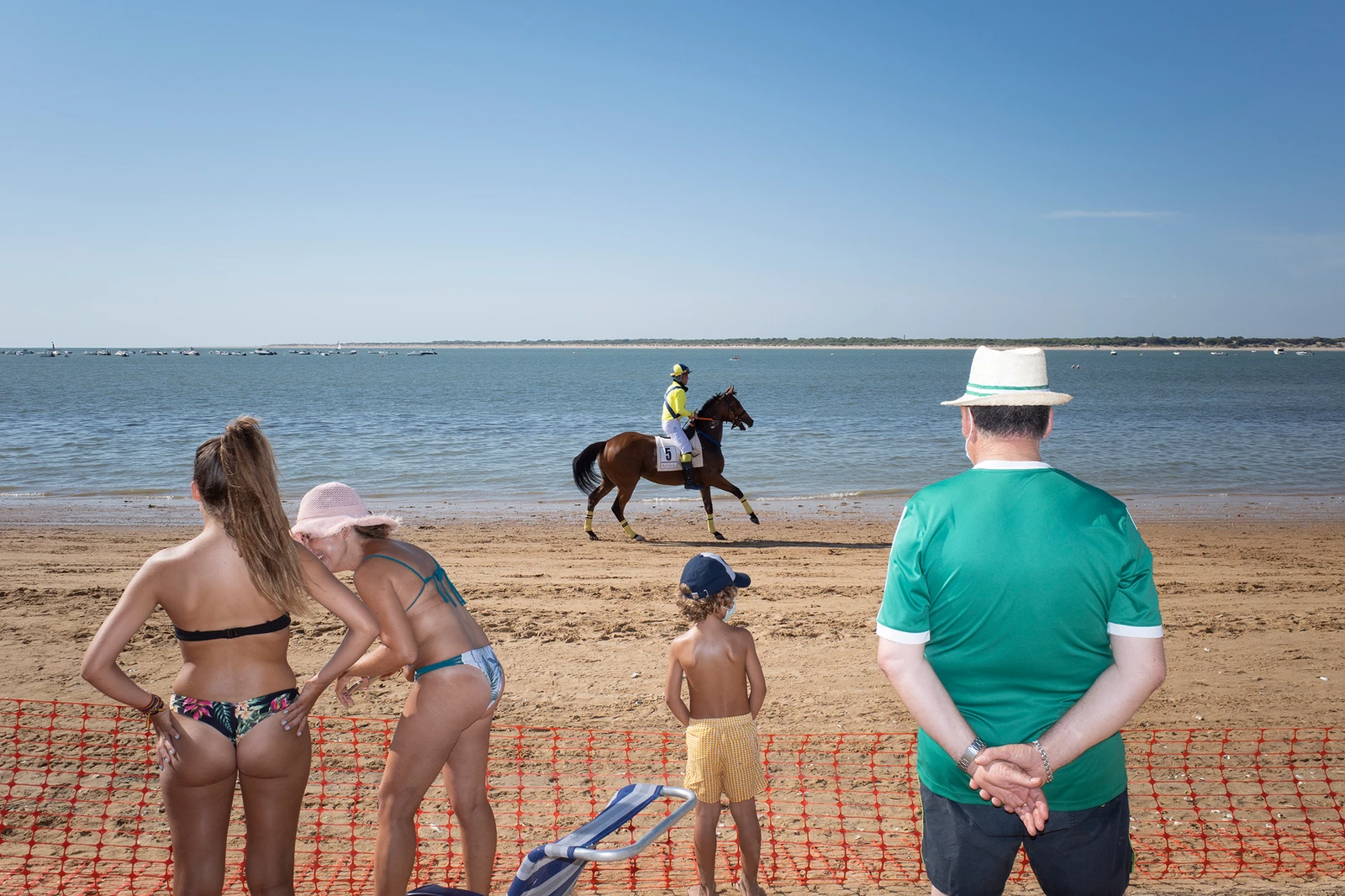
The image was taken during the famous horse races on the beaches of Sanlúcar de Barrameda, in Andalusia, a scene already rich with visual possibilities. A man in a hat occupies the foreground while girls in bikinis and a child fill the middle ground, all of them absorbed in the spectacle. Above the child, a horse and rider are positioned with surgical precision, creating a surreal juxtaposition between the ordinary beach scene and the extraordinary event unfolding around it. Hand gestures, body language, the scattered attention of the crowd; every element contributes to a composition that feels both spontaneous and meticulously constructed.
What elevates this from a documentary moment to something approaching art is Vegazo's understanding of the layered frame. Nothing here is accidental. The contrast between subjects, the casual beachgoers and the powerful animal, creates what Vegazo himself describes as a cognitive friction. The viewer's eye moves restlessly across the frame, discovering new relationships between figures, new tensions between the ordinary and the surreal. The beach setting provides a warm, sun-drenched palette that grounds the image in place and season.
This is street photography as formal composition. Vegazo clearly understands that the beach, like the street, is a stage where geometry, light, color, and human presence converge. Every element works in concert—the hat, the gestures, the horse suspended above the child. The photograph rewards sustained looking, revealing itself gradually to viewers willing to slow down and parse its layers.
It is the work of a photographer who sees in frames, who understands that the strongest street photographs are those that feel both inevitable and impossible.
Interview with Álvaro Vegazo
How would you describe your photography in one sentence to someone who's never seen your work?
I consider my photography to be street photography or documentary, depending on the intention: sometimes I seek the spontaneity and intensity of the former, other times to tell stories with greater depth than the latter allows.
What draws you to street photography? Was there a specific moment or image that pulled you in that direction?
I'm drawn to the challenge of capturing those moments that often go unnoticed, that we can't observe unless we have the curiosity of a child. The turning point came after participating in a documentary photography workshop in Morocco in 2015: when I returned from the workshop, I began to feel the need to photograph in the street, where the human element was the protagonist.
Can you walk us through a typical day of shooting on the street? How do you decide where to go?
Normally, when I go street photography, I go with an open mind to whatever I find, but if there's a street event with a lot of people, I prefer to go there because it increases the possibilities: I start connecting with the surroundings and avoiding distractions, almost like a meditation exercise, until I let myself go and get excited by what I see, stopping to work on that scene that caught my attention.
Tell us the story behind the image we selected for the exhibition. Where were you, and what was happening?
This photograph was taken during the famous horse races on the beaches of Sanlúcar de Barrameda, in Andalusia, southern Spain. That day, like any other, I was looking for scenes that would move me or convey something to me, and I came across this contrast between the man with the hat, the girls in bikinis, and the child. So I started working on the scene, knowing that the horses were heading towards the starting line. I waited for something interesting to happen. In that process, I decided compositionally that the horse should be positioned directly above the child, and although the woman with the hat moved at that moment, I liked the hand gestures of the other people involved. Ultimately, I think the resulting scene creates a certain cognitive friction, both because of the surreal nature of the scene with the presence of the horse and because of the contrast between the subjects.
Is this image part of a larger series or project? If so, what's the broader story you're telling?
Yes, this is a photograph that could be part of a project I've been working on for years about horse races on the beach. The races take place in the summer, in two three-day cycles, so I don't have much time to capture images. For now, I'm focusing on taking photographs without a specific story to tell; perhaps in time they will have a story to tell, or perhaps they simply capture the atmosphere of these beaches every August during the races.
Is there something about exhibiting in Barcelona specifically that excites you?
Of course! It's always exciting to exhibit, especially in a city like Barcelona, sharing the space with other photographers. These are very interesting opportunities because, for me, the ultimate expression of any photograph should be its print on paper, which truly connects us to people and moves us away from social media.
How has having a portfolio website impacted your work or career as a photographer?
It's had a positive impact because, in addition to keeping my work organized in an intuitive way for everyone, it's opened doors to jobs, collaborations, and image sales. I think it's the best way for others to evaluate your work, like a portfolio, because it shows what you want to show, directly, without algorithms.
Exhibition Details
ImageNation Barcelona 2026
May 29–31, 2026
Barcelona, Spain
Discover more of Álvaro Vegazo's work at www.alvarovegazo.com.