ImageNation Barcelona 2026 | Selected Photographer
The Photographer & The Work
Paulina Gallardo's portrait photography operates in a register of profound tenderness. Her work has always been about trust; the kind that exists between photographer and subject, but also between the subjects themselves. For ImageNation Barcelona, she has offered us an image that stops time around a moment of genuine human connection.
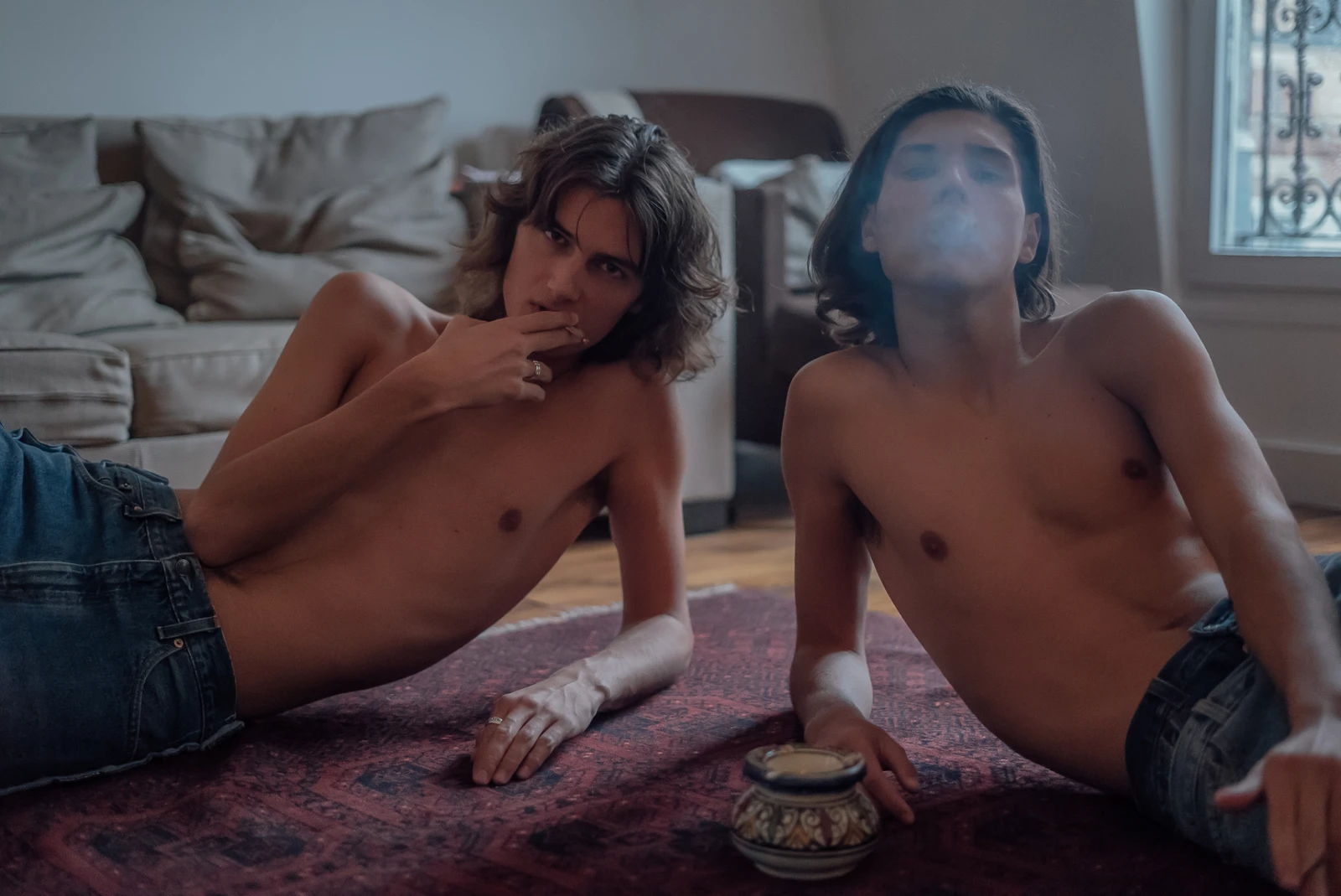
Two young men occupy a worn Persian rug, bare-chested, existing together in a language beyond words. One is mid-cigarette; the other exhales smoke into the warm amber-toned light that defines the frame. The scene is unhurried, unguarded, intimate in a way that only emerges when subjects feel truly seen. There is no performance here, only presence.
The technical sophistication of Gallardo's work lies in her colour palette and her understanding of light. Denim, burgundy, skin tones, and the aged fabric of the rug create a chromatic whole that feels both specific and timeless. The amber light is neither harsh nor forgiving; it is honest. It reveals skin, texture, vulnerability. The composition allows the figures to breathe, to exist in their own space without intrusion.
What makes this image remarkable is its demand on the viewer. Gallardo's photography asks us to slow down, to sit with discomfort, to recognise the weight of being fully present with another human being. In an era of disposable imagery, her work operates as a corrective, a reminder that portraiture can be an act of care, not consumption. The cigarette smoke becomes almost poetic: breath made visible, the exchange of self between two people who have given their trust to the photographer's lens.
This is portrait photography at its most essential.
Interview with Paulina Gallardo
How would you describe your photography in one sentence to someone who's never seen your work?
My photography is a cinematic exploration of people and places, where editorial, documentary, and personal narratives merge into a poetic visual language.
What draws you to intimate, trust-based portraiture? Was there a specific moment or image that pulled you in that direction?
I'm drawn to photographs that speak and invite rather than simply show. To create that, I need to be present within the situation I'm photographing, there is always a search for closeness and a trace of that intimacy in the image. With a background in film, I've always been interested in movement within stillness, and I try to build images that feel like part of a sequence, where the viewer imagines what came before and what might come after the frame.
What does your creative process look like before you even pick up the camera?
I usually have a general idea in mind before any shot, but I don't like to keep my concept too rigid. I don't often rely on moodboards, except when it's an editorial series, because I prefer to have space for spontaneity. I believe that allowing the unexpected to enter the process brings more continuity. lived experience, and realism to the image.
Can you walk us through a typical shoot? How much is planned versus spontaneous?
As I mentioned earlier, I always start with a clear idea in mind. This includes the emotion, the color palette, and the overall atmosphere I want to create. However, spontaneity plays a very important role throughout the shoot.
In the case of editorial work, I usually prepare a moodboard more as a tool to communicate with the team and build trust around the concept, rather than as something that defines my own creative process. It helps create clarity and alignment, even though my mind often moves faster than any reference.
When it comes to more documentary based work, prior connection and coexistence are essential. The subjects need to feel completely safe, comfortable, and confident with my presence and my way of working.
Tell us the story behind the image we selected for the exhibition. Where were you, and what was happening?
This photograph is very important to me in terms of time and memory, as it was taken during the COVID-19 lockdown in Paris, a period of extremely strict isolation. We spent almost two years in a state where life felt suspended, and we had almost forgotten the meaning of social interaction.
During that surreal moment, my partner, who appears on the left of the image, and I invited a friend and a model, Malo, to our home. It was a small but very meaningful moment of social connection, experienced under the pressure of prohibition and isolation. In that context, I felt a strong desire to create something, almost as an attempt to generate a fleeting sense of spontaneity and joy. That is how "BOCANADA" was born, an image that emerges from a moment of rare purity and presence, where something seemingly ordinary became deeply significant because of the circumstances we were living in. The simple act of being together.
That is why it is so meaningful for me that this photograph was selected, as it makes me realize that even in the most difficult moments, when time seems to disappear, an image can become significant and timeless.
What does it mean to you to have your work professionally printed and framed for a gallery?
It is a true honor for me to have been selected by this jury, and I am especially grateful for this recognition from Portfoliobox. For me, having my work displayed in a gallery is much more than an achievement; it is the materialization of a process that only feels complete when it is shared. It becomes a way of offering a moment, an experience, my gaze and my perspective, inviting others to step into the universe that exists within my images.
I am truly grateful to be part of this exhibition. Thank you, Portfoliobox.
What are you working on right now? Any projects or series in progress?
Right now, I am very interested in exploring masculinity through my work. As a female photographer, I have noticed certain dynamics, especially within the fashion world, which is still largely male-dominated, and this has led me to become particularly interested in photographing men.
What I find compelling is the idea of portraying male subjects from a different perspective, one that comes from a female gaze, and exploring how this can shift the way masculinity is represented and perceived.
However, my relationship with masculinity goes beyond editorial work. I am also developing more documentary-based projects where I immerse myself in exclusively male environments, using photography as a way to observe and reflect not only the subjects themselves, but also my own experience as a woman within these spaces.
How long have you been using Portfoliobox, and what made you choose it for your portfolio?
I have been using Portfoliobox for more than ten years. I first discovered the platform when I began exploring my creative process through artist friends while I was living and studying in Sweden. Many creatives around me were using it at the time, and since then, I have never doubted continuing with it.
What I appreciate most is its aesthetic quality, which is very important for me when presenting my work, and the ease of use. It allows me to find tools that support clear navigation and create a comfortable experience for the viewer.
Exhibition Details
ImageNation Barcelona 2026
May 29–31, 2026
Barcelona, Spain
Discover more of Paulina Gallardo's work at www.paulinagallardo.com