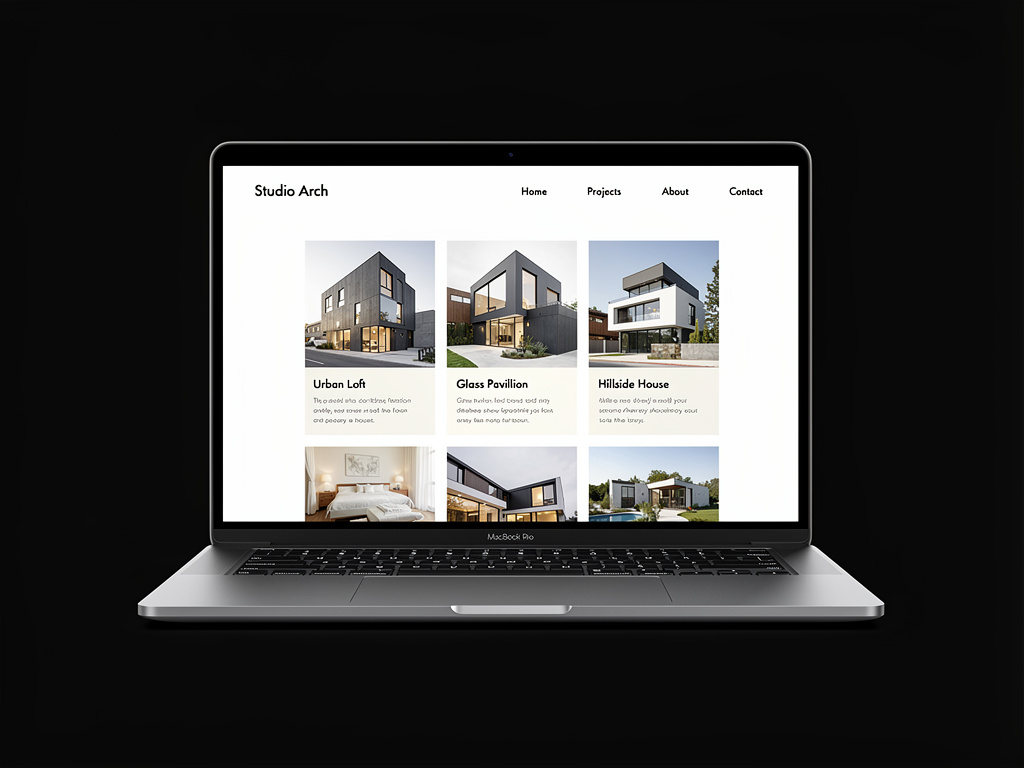
Compiling a body of architectural work is uniquely challenging. Unlike graphic design or photography, your final product is typically a massive physical structure or a highly detailed spatial environment. Determining how to effectively compress three-dimensional space, years of planning, and technical rigor into a two-dimensional website is the true test of your presentation skills.
When examining the most successful architecture portfolio examples, distinct presentation patterns emerge. Here are the five critical concepts you must master to elevate your architectural portfolio from a mere technical archive to a compelling visual narrative that wins bids and attracts prestigious firm offers.
1. Establish Rhythm Between The Technical and The Visceral
An architecture portfolio that consists entirely of dense CAD plans is impenetrable to a layperson. Conversely, a portfolio featuring only glossy 3D renderings often feels disconnected from the brutal realities of structural engineering and material science.
The best architecture portfolios establish a deliberate rhythm. Start the presentation of a project with a striking, atmospheric rendering or high-quality final photograph (if built). Once you have established the mood and scale, dive into the structural logic. Introduce the site plans, the elegant axonometric diagrams, and the detailed sections. Provide the "wow" factor first, and immediately support it with undeniable technical competence.
2. Diagrammatic Restraint
While in school, many aspiring architects clutter their presentations with dozens of complex, overlapping diagrams detailing wind flow, sun paths, and circulation to prove they did the research. In a professional digital portfolio, this is exhausting.
Curate your diagrams with extreme restraint. Select only the one or two critical diagrams that perfectly explain the central thesis of the building's intervention. Present them crisply and uniformly. Ensure that the visual language (line weights, colors, typography) of your diagrams matches the overarching aesthetic of your website.
3. Scale and Proportion on the Screen
In physical portfolios, architects meticulously manage white space and scaling to ensure their drawings look immaculate at 1/8" = 1'-0". Transitioning to the digital realm requires a different approach to scale.
Because viewers may scroll your site on an enormous desktop monitor or a 6-inch phone screen, do not rely on standard architectural scaling rules. Instead, focus on visual hierarchy and high-resolution zooming. Guarantee that your intricate section drawings are uploaded at a high enough resolution to allow viewers to click, enlarge, and inspect the fine linework without encountering pixelation.
4. The Narrative Anchor
Every building tells a story about its environment, its users, or its materials. Anchor each of your projects with a concise narrative paragraph. Instead of just titling a project "Mixed-Use Residential Block," describe the conceptual driver: "A passive-solar residential intervention utilizing local reclaimed timber to bridge the gap between historic district massing and modern sustainable performance."
A powerful two-sentence explanation provides massive context and prevents your work from being viewed merely as geometric shapes on a screen.
5. Curating the "Unbuilt" Seamlessly
For young architects or those working at larger firms, a significant portion of your portfolio may consist of unbuilt competition entries or academic explorations. Do not segregate these or treat them as inferior. Curate and render them with the exact same gravity and detail as your built work to showcase your pure conceptual abilities.
Your architectural work warrants an elegant, highly structured environment. With Portfoliobox, you can effortlessly create a bespoke portfolio website that presents your complex drawings and massive renderings with sophisticated precision.