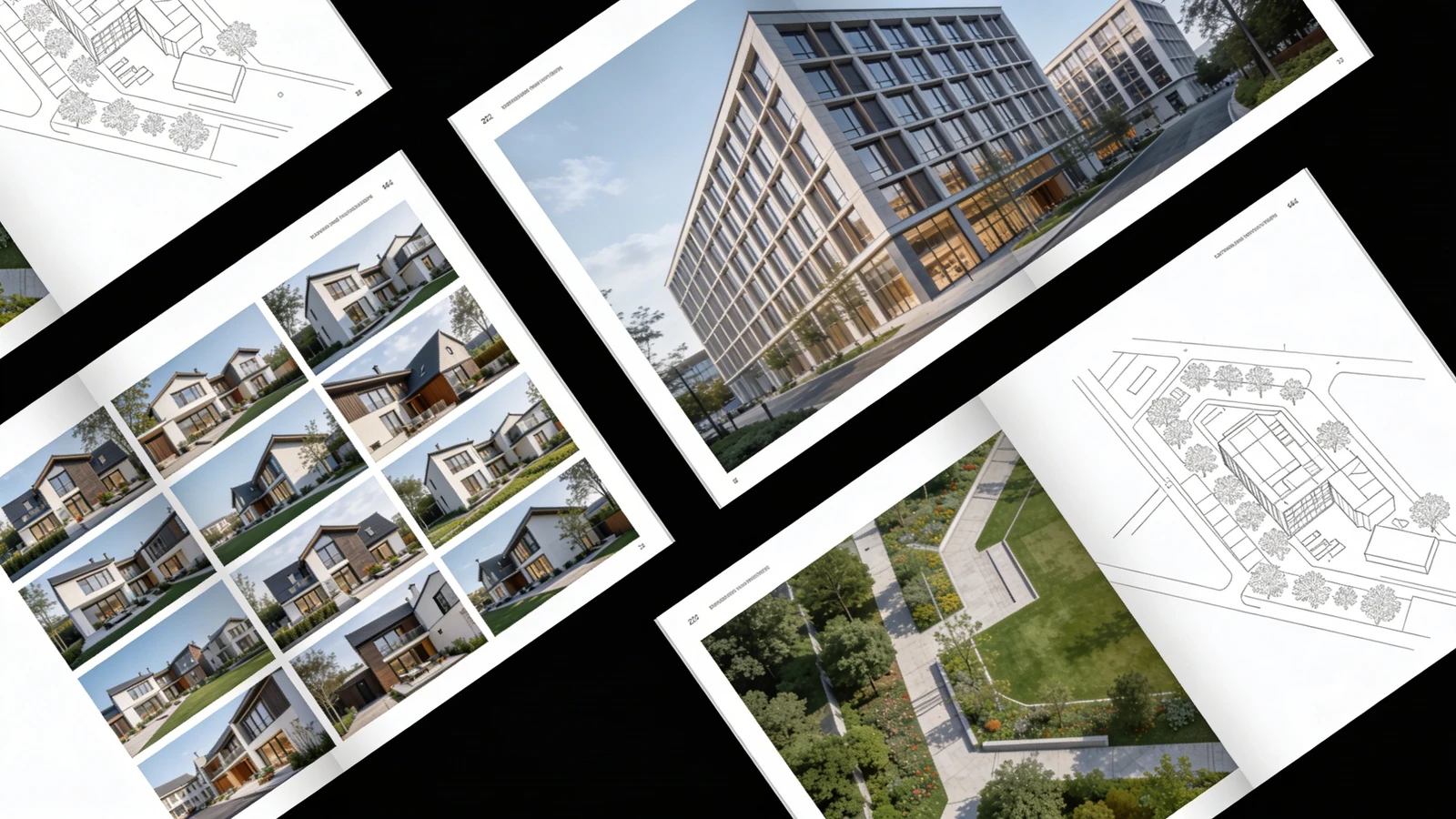
It was 11:30 PM on a Tuesday, and Sarah was staring blankly at her screen. She had spent the last four hours trying to fit the extensive CAD drawings, renders, and site analysis of her final master’s project into a layout that felt right. But no matter how she arranged the grids, her professional architecture portfolio felt less like a compelling narrative of her spatial design abilities and more like a cluttered technical manual.
She was applying for a junior architect role at a firm she had admired for years. She knew her work was good—her professors had praised her innovative approach to sustainable materials—but translating that physical and spatial brilliance into a digital format was proving to be a monumental challenge.
This is a scenario almost every architect faces. We are trained to design buildings, spaces, and environments. We understand how light washes over concrete, how circulation paths dictate human behavior, and how structural integrity marries aesthetic vision. But when it comes to designing the vessel that holds this work—our professional architecture portfolio—we often hit a wall.
The secret behind a successful professional architecture portfolio isn’t just about showing that you know how to use Revit or Rhino. It’s about storytelling. It’s about curating a journey for the reviewer, guiding them through your design process, and proving that you can think critically about space. A truly effective portfolio doesn't just display your past work; it actively builds your future career.
The Myth of the "Complete" Portfolio
The most common mistake architects make when compiling their work is attempting to show everything. Sarah’s initial instinct was to include every floor plan, every section, and every iterative sketch of her master’s project. The logic seems sound: If I show them everything I can do, they’ll see my full value.
In reality, the opposite is true. A professional architecture portfolio must be an exercise in ruthless editing.
When an architecture firm is hiring, the principal or hiring manager might spend only two to three minutes reviewing a portfolio before making a decision. In those critical minutes, they aren't looking for exhaustive documentation. They are looking for clarity, intentionality, and a strong design voice.
By overwhelming the viewer with too much information, you dilute the impact of your strongest work. The secret is to curate. Select projects that not only demonstrate your technical proficiency but also highlight your unique approach to problem-solving. If a drawing doesn't directly support the narrative of the project, cut it.
Structuring the Narrative Arc
If a portfolio is a story, then the projects are its chapters. But a story needs a structure to make sense.
Think of your portfolio like a well-designed building. It needs a strong foundation, a logical flow, and moments of pause and impact. Start with a project that immediately establishes your design philosophy. This is your "lobby"—it needs to be welcoming, impressive, and indicative of what’s to come.
Follow this with projects that demonstrate different facets of your skill set. Perhaps one project highlights your rigorous site analysis and urban planning capabilities, while another showcases your sensitivity to interior detailing and material selection.
In Sarah’s case, she eventually realized that her master’s project was best served by focusing on the core concept: a modular housing system. Instead of showing every structural detail, she focused on the diagrams that explained the modular logic, paired with a few stunning renders that captured the atmospheric quality of the spaces.
The Power of Process Over Product
One of the greatest misconceptions about the professional architecture portfolio is that it should only feature the polished, final results. While high-quality renders and crisp vector graphics are essential, they only tell half the story.
Firms want to see how you think. They want to know how you arrive at a solution. This is where process work becomes invaluable.
Include concept sketches, physical models (even the messy study models), and iterative diagrams. Show the evolution of an idea from a napkin sketch to a developed spatial concept. This not only humanizes your work but also proves that your final designs are the result of a rigorous intellectual process, not just arbitrary aesthetic choices.
When Sarah decided to include a scan of her initial, heavily annotated sketchbook pages alongside the final renders of her modular housing project, she noticed a shift. In interviews, directors didn't just compliment the renders; they engaged with her thought process, asking questions about the decisions she made along the way.
Typography and White Space: The Invisible Architecture
As architects, we understand the importance of negative space. We know that the space between buildings is just as important as the buildings themselves. Yet, when designing a professional architecture portfolio, we often forget this principle, cramming every inch of the page with images and text.
White space (or negative space) is crucial in portfolio design. It gives the viewer’s eyes a place to rest and creates a hierarchy of information. It allows your best work to breathe and be appreciated without distraction.
Similarly, typography should be treated with the same respect as building materials. Choose clean, legible fonts. Create a clear typographic hierarchy—a distinct style for project titles, headings, body text, and captions. Consistency in typography and layout creates a cohesive rhythm throughout the portfolio, making it feel like a single, unified document rather than a disjointed collection of projects.
Tailoring Your Portfolio to the Audience
A professional architecture portfolio shouldn't be a static document. It should be a flexible tool that adapts to its audience.
If you are applying to a firm known for its parametric design and cutting-edge digital fabrication, your portfolio should highlight projects that demonstrate these skills. If you are approaching a boutique firm specializing in historic preservation, focus on your sensitivity to context, material analysis, and hand-drafting abilities.
This doesn't mean you have to redesign your entire portfolio for every application. Instead, maintain a master archive of your work and curate specific selections tailored to the role or firm you are targeting. This targeted approach shows that you have done your research and understand the specific value you can bring to their team.
The Digital Presence: Beyond the PDF
While the PDF portfolio remains a standard in the industry, relying solely on it is a missed opportunity. In today's digital landscape, a professional architecture portfolio must exist online.
A personal website allows you to break free from the linear constraints of a PDF. It offers a dynamic platform where projects can be explored interactively. It also serves as a central hub for your professional brand, linking to your resume, your LinkedIn profile, and perhaps even a blog where you share your thoughts on architectural trends.
More importantly, a website makes you discoverable. An optimized online portfolio can attract clients or employers who are searching for specific architectural skills, rather than you having to constantly reach out to them.
When Sarah finally built her online portfolio, she found that she wasn't just applying for jobs; opportunities were starting to find her. A local developer stumbled upon her website, impressed by her modular housing project, and reached out to consult on a new sustainable housing initiative.
Building your digital presence doesn't have to be complicated. With Portfoliobox, you can create a stunning professional architecture portfolio website in minutes — no coding required. It provides the clean, customizable templates architects need to let their work take center stage, ensuring your online presence is as carefully considered as your designs.