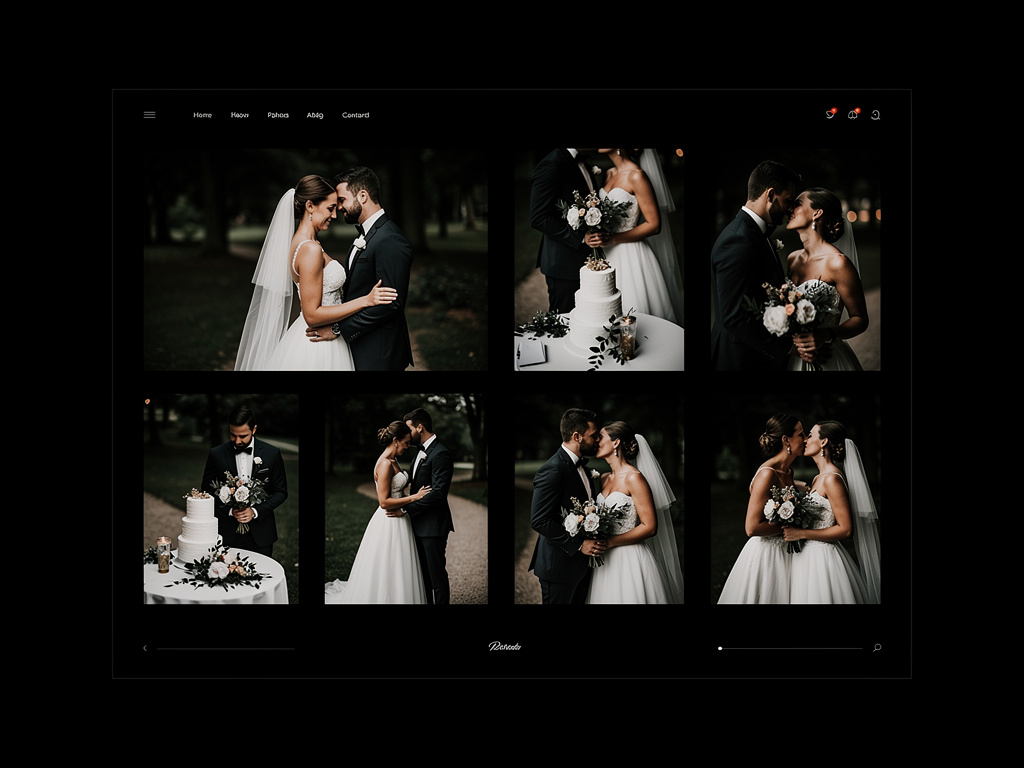
Young creatives generally operate from a place of intense professional anxiety. To prove to a hiring manager that they are "hard workers," they assume they must show everything they have ever created.
When they build their first professional art portfolio website, they upload massive amounts of visual data: forty corporate logos, twenty abstract paintings, sixty sketchbook pages, and three unfinished 3D modeling animations. They assume the hiring manager will filter through the chaos and find the masterpiece.
Corporate Art Directors do not have time to filter chaos. If an Art Director clicks your website and sees a grid containing your brilliant, $10,000 corporate rebranding project sitting right next to a terrible, messy pencil sketch of a dog you drew in 2018, the bad art actively deletes the good art. The Art Director assumes you got lucky on the re-brand, and your actual skill level is the dog drawing.
To command elite gallery prices or agency salaries, you must stop operating like a frantic hobbyist and start operating like a ruthless Museum Curator. Here is the exact B2B logic for curating the perfect creative portfolio.
Rule 1: The Principle of Lowest Quality
Your digital portfolio is entirely mathematically defined by its absolute weakest link.
The Psychological Reality: If you show a recruiter exactly three incredible pieces of graphic design, they will subconsciously extrapolate that all of your un-seen work is equally incredible. If you show them three incredible pieces of graphic design, followed by two terrible pieces of graphic design, their brain immediately calculates risk. They will assume that if they hire you, there is a 40% chance you will deliver terrible work. They will not hire you.
The Curation Filter: Before you upload an image to your website website, ask yourself: "Would I be proud to show this specific image to the exact Art Director at the exact company I want to work for?" If the answer is barely a 'Yes', you must permanently delete it from the folder.
Rule 2: Establishing The 'Killer Application'
Curating is not just about deleting bad art; it is about aggressively framing your best art.
The Hero Asset Law: When you build your website navigation, do not utilize a purely chronological grid (putting your newest work at the top and oldest at the bottom). A recruiter might bounce from your site in 5 seconds. You cannot hope they eventually scroll down to find your masterpiece.
You must deploy your "Killer Application" immediately. Locate the single greatest, highest-converting corporate or fine art project you have ever executed. Format this specific project massively. Give it a dedicated Hero Banner above the fold of your homepage, or dedicate an entire structural sub-page to it as a massive Case Study. You must guarantee that even if the Art Director only spends exactly one second on your website, they see the absolute peak of your technical capability.
Rule 3: The Destruction of Nostalgia
The hardest part of curation is overcoming your own emotional attachment.
Artists frequently keep terrible artwork on their professional websites simply because that specific project holds a deep, nostalgic memory for them (e.g., "This is the first painting I sold at a coffee shop!"). A B2B hiring entity parsing thirty websites an hour does not care about your feelings or your nostalgia. They care about commercial execution.
Your portfolio is a living corporate document. It is not an archive.
The Rolling Deletion Strategy: Every time you complete a brand new, elite project and add it to your website, you must locate the single weakest piece of art currently surviving on your grid and permanently delete it. By continuously raising the floor, your perceived corporate value accelerates exponentially.
Commanding elite pricing requires an ecosystem built for calculated restraint. By moving your creative career to Portfoliobox, visual originators intuitively deploy the stark negative space matrices, uncompressed UI layouts, and sophisticated architectural designs required to make ruthless curation look incredibly easy — no coding required.