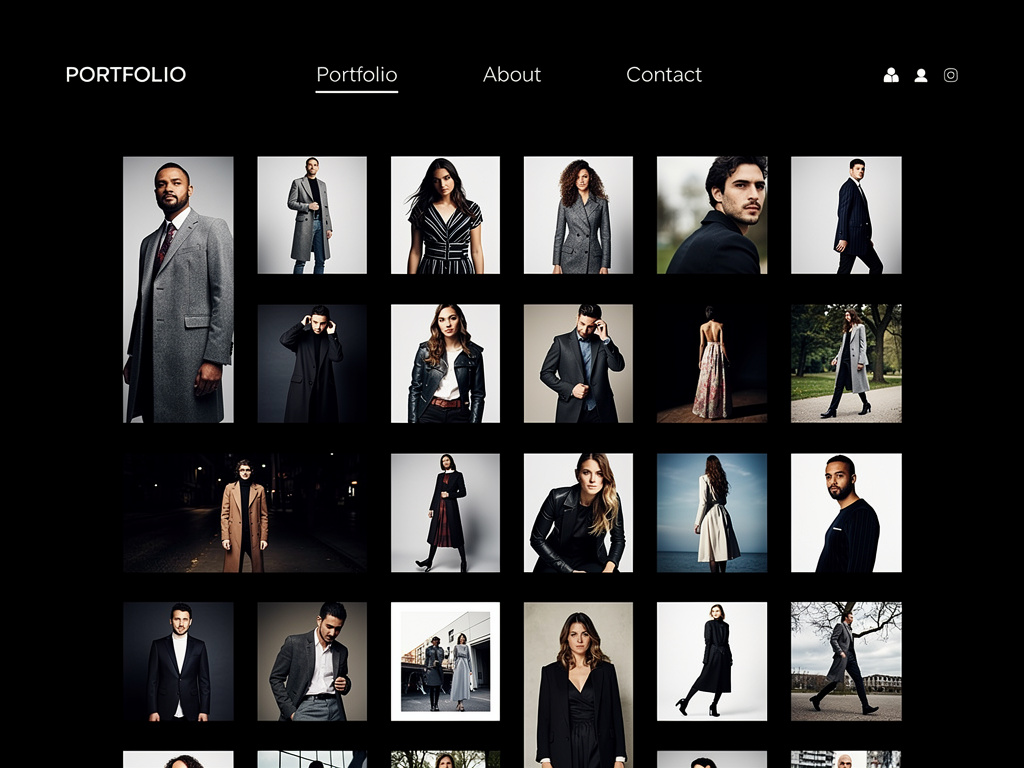
The classic paradox of jumping from art school into the professional commercial photography industry is brutal: you cannot get a big client without an impressive portfolio, but you cannot build an impressive portfolio without big clients.
Photography students often panic during their senior year because their digital portfolios consists entirely of classroom lighting exercises, photos of their roommates, and a few abstract thesis projects. They look at the massive, highly-produced agency websites of established professionals and feel entirely outclassed.
However, art directors and commercial editors know everyone starts somewhere. They are rarely looking for an exhaustive 10-year client history from a recent graduate; they are looking for raw vision, technical competence, and digital polish. Here is how to construct a digital portfolio that punches far above your actual career level, utilizing the assets you already have.
The Power of the 'Self-Assigned' Spec Campaign
If you want to be hired by Nike, you do not need Nike to hire you first to take a Nike-caliber photograph.
The most powerful tool a student possesses is the "Speculative (Spec) Campaign." To fill the gaping commercial holes in your digital portfolio, self-assign a massive project. Select a brand you admire, rally your classmates or local models, secure clothing, and execute a high-end shoot exactly as if the brand were paying you.
When you upload this to your digital portfolio, format it proudly as a 'Concept Shoot'. Detail the lighting diagrams, the creative brief you wrote for yourself, and the final retouched tear sheets. An art director reviewing your site recognizes the hustle instantly. They see that you understand commercial lighting and narrative direction, effectively sidestepping the fact that you haven't technically been paid yet.
Relabeling 'Homework' into Professional Nomenclature
Words have immense power in shaping perception. The quickest way to ruin your digital credibility is by naming your website galleries "Assignment 3: Strobe Lighting" or "Junior Year Darkroom Final".
You must translate academic exercises into standard industry nomenclature.
- A classroom assignment photographing bottles of perfume is relabeled online as "Commercial Product & Still Life Studies."
- A semester spent photographing strangers on the subway becomes "Urban Documentary Projects."
- A series of your roommate posing with different outfits shifts to "Editorial Portraiture."
By simply adopting the language of the working industry, your digital folder structure instantly feels professional and mature.
Emphasize 'Behind the Scenes' Competence
Professionals want to hire assistants and junior shooters who will not embarrass them or freeze up when a strobe light misfires on set.
If you are lacking final, massive commercial images, compensate by proving extreme technical competence. Dedicate a sub-section of your portfolio to 'Behind the Scenes' (BTS) or 'Process' imagery. Show sharp, well-edited photos of yourself gripping C-stands, operating medium format cameras on location, or utilizing complex tethered shooting workflows on a laptop. Proving that you are immediately useful on a real commercial set often secures your first high-paying assisting gig, which eventually leads to shooting gigs.
Presenting the 'Unified Aesthetic'
A student portfolio often looks chaotic because academic curriculums force you to shoot ten different genres (landscape, macro, fine art, portraiture) to pass the class.
When building your public digital portfolio, you must violently abandon the curriculum. You are no longer trying to prove to a professor that you know how to use a macro lens; you are trying to prove to an agency that you have a distinct visual voice. Curation is your most potent weapon. Select only the 15 images from your entire college career that share a unified aesthetic, color grade, and conceptual tone. If a photo doesn't fit the 'vibe', even if it got an A+, it stays off the site.
You don't need a high-end agency budget to create a high-end digital presence. Using Portfoliobox, students can effortlessly establish clean, professional domains, organize spec campaigns into elegant grids, and strip away the "amateur" look in minutes — no coding required.