Marcus had just graduated from an elite architectural university. His spatial reasoning was brilliant. His parametric rendering skills were unparalleled. Confident in his abilities, he built a massive 60-page digital portfolio, uploaded every single building he had ever conceptualized, and sent the link directly to the top ten commercial firms in New York City.
He received zero interview requests. After three months of devastating silence, a Junior Associate at one of the firms finally replied to his email with brutal honesty: "Your work is brilliant, Marcus. But your portfolio website crashed my browser twice, I couldn't find your resume, and six of your structural diagrams had massive spelling errors in the annotations. We assumed you lack the attention to detail required to engineer a safe building."
Architecture is inherently a discipline of precision. If your portfolio layout implies that you are sloppy, the firm assumes your buildings will be sloppy. Here are the catastrophic architecture portfolio mistakes currently disqualifying you from the hiring pool, and exactly how to fix them.
The Crime of the 'Information Dump'
The most common mistake young architects make is associating "volume" with "value."
If a Senior Partner clicks your portfolio URL and is immediately confronted by a chaotic, unorganized grid of forty different projects, they experience instant cognitive fatigue. They do not have the time to hunt for your best work.
If you bury your masterful, award-winning Urban Housing Thesis underneath fifteen mediocre freshman-year sketching assignments, you are forcing the partner to judge you on your weakest links.
The Fix: You must ruthlessly execute the "Rule of 6." Limit your entire digital portfolio to your six absolute best projects. Ensure every single image on your website represents the highest echelon of your current ability. A deeply curated, six-project portfolio projects immense confidence; a forty-project portfolio projects desperation.
Spelling Errors in Technical Jargon
Architecture relies on a highly specific, standardized vocabulary. You are communicating with engineers, city planners, and contractors.
If a hiring manager zooms into one of your complex HVAC blueprints online and sees that you misspelled "Cantilever," "Load-Bearing," or "Reinforced Concrete" in your text annotations, your application is dead. In the physical construction world, a typo on a dimensional blueprint costs a developer a million dollars. Firms hire architects who are obsessively detail-oriented.
The Fix: Never upload text directly baked into your CAD drawings if you can avoid it. Extract your heavy technical drawings cleanly, and use your website platform's native spell-checking text editor to annotate the layouts. Have a peer review every single word of your project brief before clicking 'Publish.'
The "All Renders, No Process" Trap
Firms do not hire junior architects to generate pretty pictures all day; they hire them to solve ugly structural problems.
If your portfolio consists entirely of hyper-realistic, perfect Lumion exterior renders, but completely lacks any floor-plans, wall sections, or structural details, the firm will assume you don't actually know how to build a building. An "all renders" portfolio makes you look like a graphic artist, not an architect.
The Fix: For every glamorous 3D exterior render you upload, you must provide its technical counterpart. Show the specific 2D section-elevation that proves you understand how the roof physically attaches to the foundation. Ground your beautiful aesthetics in harsh, undeniable physics.
Crashing the Partner's Browser
Architects generate massive files. A single uncompressed TIFF rendering could be 80 Megabytes. If you upload ten of those to a single web page on a cheap website builder, the total weight of the page becomes a gigabyte.
When the Senior Partner attempts to open your site on their MacBook, the browser will likely freeze, buffer endlessly, or crash completely. You just wasted their incredibly expensive time.
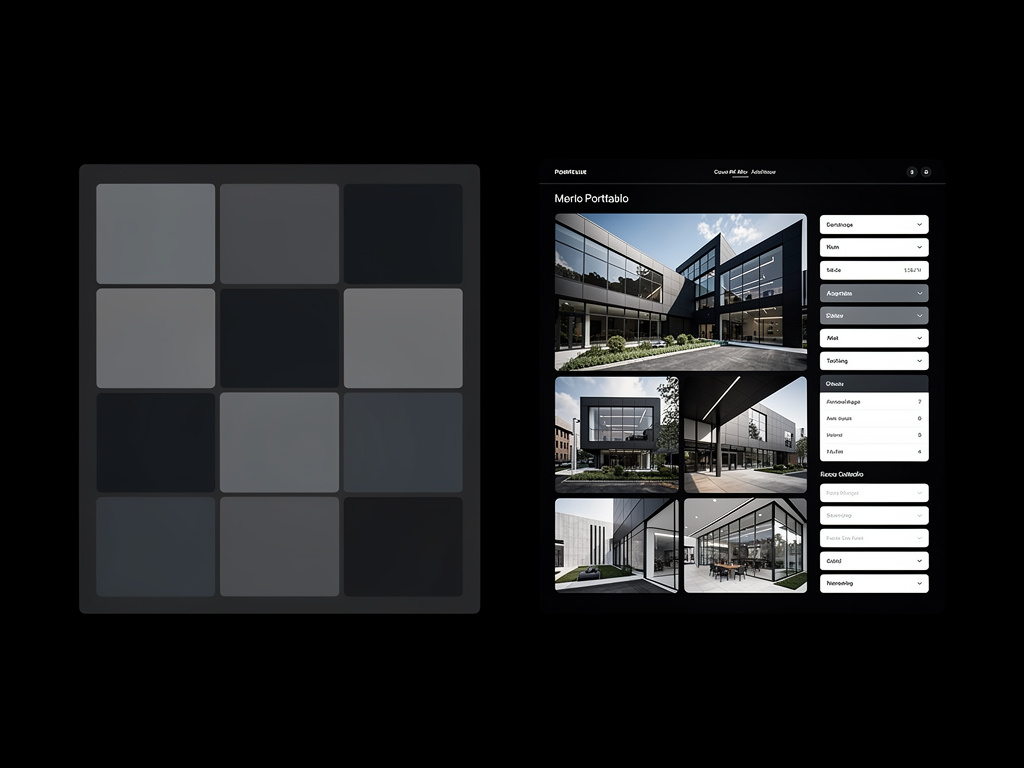
The Fix: Optimize your data. You must utilize a web platform specifically engineered for heavy visual hosting. By migrating your massive 3D renders onto Portfoliobox, you leverage automatic, lossless WebP compression and sophisticated unmetered CDNs, guaranteeing your heavy structural models load instantly without penalizing the hiring manager's browser — no coding required.