When an architectural student constructs their portfolio, the entire goal is to prove spatial creativity. They want to show how radical and philosophical their geometry can be.
However, when you are running a professional firm competing for a $200 million civic contract or a luxury residential development, your portfolio serves an entirely different function. The client reviewing your website—whether it is a hospital board of directors, a municipal government, or a private equity group—does not care about your spatial philosophy. They care about risk.
Constructing a massive building is financially terrifying. If a firm's website is disorganized, overly abstract, or difficult to navigate, the client will immediately associate that chaos with how you manage construction budgets. To win massive modern bids, your professional architecture portfolio must be structurally engineered to communicate absolute financial and logistical safety.
The Downward Shift of Technical Drawings
The most common mistake practicing architects make is presenting their digital portfolios exactly to the students they used to be, flooding the top of their project pages with dense, unreadable AutoCAD floor-plans and section details.
A city council member reviewing your bid does not know how to read a structural HVAC section. Do not confuse them.
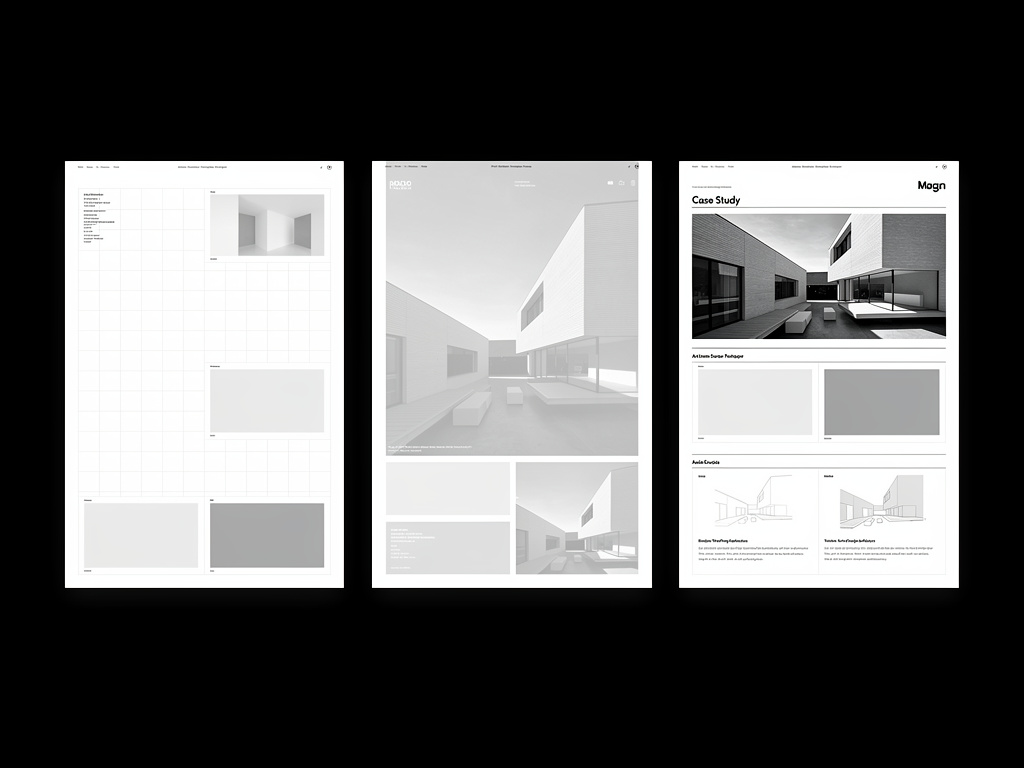
In a commercial portfolio, you must invert the hierarchy. The top 75% of your project page should be utterly dominated by reality: high-definition photography of the finished, built environment. Show humans using the space. Show the sunlight hitting the lobby. Only at the very bottom of the case study, clearly sectioned off, should you provide the technical orthographic drawings. Hide the math until they have fallen in love with the result.
Emphasizing the 'Constraints' Narrative
A successful commercial architectural case study is not a gallery; it is a legal defense. You must explain why the building looks the way it does.
Do not rely entirely on imagery to win a bid. Implement a rigid text block at the beginning of every project outlining the specific constraints you navigated:
- Zoning & Regulatory: ("Navigated strict historical overlay districts preventing exterior modification.")
- Environmental: ("Engineered a LEED Platinum passive-cooling system within a hurricane zone.")
- Financial/Timeline: ("Delivered a 400-unit residential tower three months ahead of the developer's schedule.")
When a new client reads that you successfully defeated zoning boards and impossible deadlines, your perceived commercial value skyrockets compared to a firm that just posts "pretty renders."
Integrating the 'Client Testimonial' Authority
In the world of high-stakes commercial architecture, social proof is the ultimate currency.
Do not hide your client testimonials on an invisible sub-page. Integrate them directly into the visual flow of the portfolio. If you successfully completed a massive corporate headquarters, feature a massive block quote from the CEO of that corporation natively alongside the photographs of the boardroom.
Tying the visual proof of the built environment directly to the verbal praise of a recognizable financial entity completely eliminates the perceived risk for the next client reviewing your bid.
Categorical Siloing for Specific Bids
If a school board is looking to hire an architect to design a new high school, they do not want to wade through your residential kitchen remodels to find your civic work.
A professional firm must aggressively 'silo' their portfolios using strict categorical navigation. Your homepage should immediately bifurcate into clear sectors: Civic, Commercial, Residential, Healthcare. When you submit your URL for a hospital bid, you do not just send www.yourfirm.com, you send www.yourfirm.com/healthcare, driving the board directly into a highly targeted ecosystem proving your exact specialization.
Winning commercial architectural bids requires a digital infrastructure that projects unwavering authority. With Portfoliobox, firms can effortlessly organize massive categorical silos, embed heavy narrative text blocks, and display uncompressed photography at breathtaking scales — no coding required. Explore architecture portfolio templates designed specifically for professional firms looking to showcase their most competitive work.